
Vince’s Marathon journeyFrom Out of Breath to 26.2 Miles: What Was I Thinking?!
Back in October 2025, I entered the BHFR club ballot for the 2026 London Marathon. Like most people entering ballots, I assumed my chances of getting in were somewhere between “unlikely” and “absolutely no chance.”
Then came our run group social at Babble on Wednesday 3rd December 2025, where names were being pulled from a hat for the club places.
And somehow… my name came out.
I remember feeling completely overwhelmed — delighted and horrified in equal measure. Delighted because — wow — London Marathon!
But horrified because reality suddenly hit me like a bus. A marathon is 26.2 miles. In winter. Through months of dark mornings, freezing rain, aching legs and endless training runs. And I hadn’t run a marathon in over ten years… back when my knees made less noise, recovery didn’t involve noises getting off the sofa, and I could bounce back after a run without needing a tactical nap.
For a moment I genuinely thought: “What on earth have I just signed myself up for?”
The “What Have I Done?” Phase
I started training during the week commencing 9th December because I knew I needed every possible second available to prepare.
To put things into perspective, before joining the club as a newbie in September 2025, I hadn’t run properly for over a year. I was overweight, unfit, and couldn’t run and hold a conversation at the same time.
In fact, if someone tried chatting to me while running, they’d basically get: “Yeah… I’m good… thanks… just… surviving…”
At that stage, the idea of completing a marathon felt laughable. Even a steady 5K sometimes felt like a near-death experience.
Marathon Training Becomes Your Personality
Training was tough. There’s really no glamorous way to say it.
My life became:
Go to work.
Stretch.
Run.
Stretch.
Shower.
Eat.
Sleep.
Complain about being tired.
Repeat.
I was running three or four times a week, doing two strength sessions, and had one precious rest day where I mostly walked around like I’d recently returned from battle.
Some mornings were freezing. Some runs were miserable. Some evenings after work I genuinely did not want to go out.
But somehow… I kept going.
The support from the club was amazing throughout. Everyone encouraged me when I doubted myself, and Darren — thank you for the four-hour training plan that slowly turned me from “slightly out of breath jogging to the bins” into an actual marathon runner.
And honestly, there were days I needed that encouragement more than people realised.
Finding Motivation in the Madness
People ask how I stayed motivated after work or how I dragged myself out of bed for freezing weekend long runs.
At first, seeing the excess fat disappear from my waistline was a pretty strong motivator, I won’t lie.
But something else happened too.
Once I got past the procrastination stage — which usually involved staring out the window negotiating with myself like a hostage situation — I actually started enjoying the long runs.
Those runs became my escape.
Running gave me space to think, process life, clear my head and mentally reset. There’s something strangely emotional about running for hours with nothing but your own thoughts, your breathing, and the sound of your trainers hitting the pavement.
Some runs felt hard.
Some runs felt magical.
Some runs felt like therapy.
Running really is brilliant for mental wellbeing. Even if your hips and hamstrings occasionally file official complaints.
Peak Training: AKA “Why Do My Legs Hate Me?”
As the weeks went by, the mileage increased and things got serious.
When I hit my peak 22-mile training run, I discovered that recovery now takes significantly longer in your fifties than it did in your forties. Back then I could recover from a long run with a pizza and a sleep.
Now I needed two full business days, several noises getting out of chairs, and possibly counselling.
The closer race day got, the more paranoid I became about injuries. Every tiny ache suddenly felt catastrophic.
Slight calf pain?
“That’s it. Career over.”
Tiny twinge in the knee?
“Excellent. I’ll probably never walk normally again.”
I became obsessed with protecting myself from injury. Stretching, Resting, Runners Diet, checking Google every five minutes — convinced my body was about to fall apart days before the marathon.
Looking back, I think every marathon runner goes through this stage because by then you’ve invested so much emotionally into the journey.
The London Marathon Expo
I attended the marathon expo in London to collect my race bib, which every runner must do in person.
It turned into a lovely day out and really made everything feel real. Thousands of runners all walking around pretending they weren’t secretly terrified.
You could feel the nerves and excitement everywhere.
The expo gets you into full marathon mode:
Expensive running gear everywhere.
People discussing carb loading like elite scientists.
Everyone casually mentioning half marathon PBs while I’m just hoping to survive with dignity intact.
But underneath all the nerves were excitement.
Real excitement.
After months of training, race day was finally close enough to touch.
Race Day Arrives
The big day finally arrived, and honestly, the London Marathon organisation was incredible.
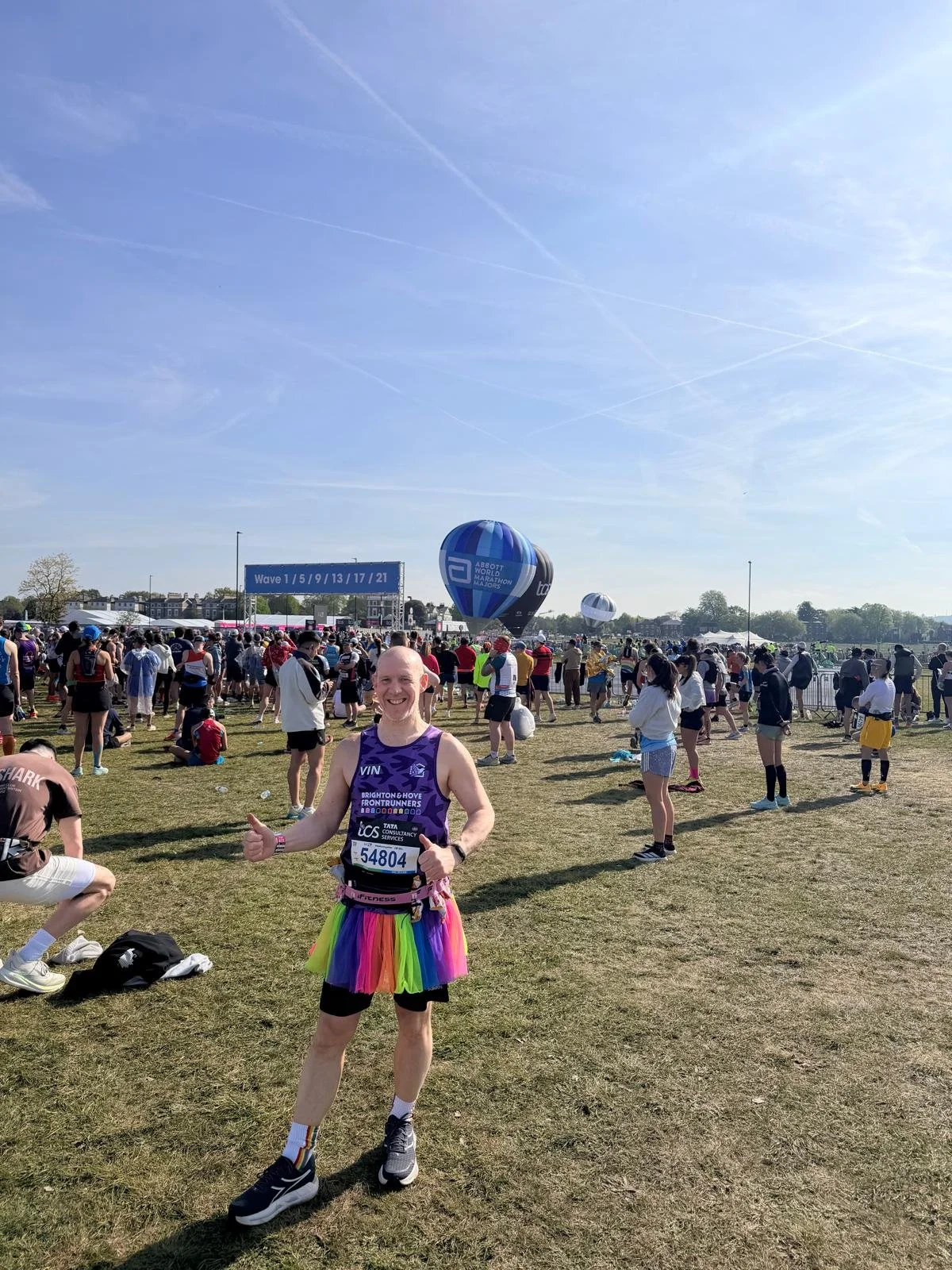
The start area in Greenwich Park was really well managed, plenty of loo facilities and clearly organised bag drops and start pens. Around 1,500 runners were allocated to each holding area across 55 separate waves, which somehow felt both crowded and amazingly efficient.
I proudly wore my club vest along with a rainbow tutu— because if you’re going to suffer for 26.2 miles, you may as well do it with style.
Standing there at the start line, what hit me most wasn’t just the nerves — it was the pride. I was representing BHFR Run Club in the London Marathon. That felt huge. It wasn’t just my run anymore; it felt like I was carrying the club with me onto the start line.
Standing there waiting to start was emotional.
Thousands of runners.
Thousands of stories.
Months — sometimes years — of preparation surrounding you.
Everyone there had battled something to reach that start line.
And then suddenly, after months of training…
We were off.
The Best Crowd You’ll Ever Experience
The support around the route was unbelievable.
Apart from one short dark tunnel, the streets were packed with people cheering every single step of the way. There were bands, DJs, performers, signs, bubbles, music and endless encouragement from complete strangers.
London really turns the marathon into one giant street party.
The noise at times was deafening.
People screamed your name from your bib as if they’d known you your whole life.
And honestly, when your legs are hurting and you’re emotionally hanging on by a thread, hearing strangers shout: “COME ON! YOU’VE GOT THIS!” means more than you can explain.
The only slightly stressful moments were around water stations, where runners would suddenly stop dead in front of you like startled deer. You quickly learn to grab water and escape back towards the middle of the road before being accidentally trampled by 60,000 determined runners.
The Moments I’ll Never Forget
One of my favourite parts was Rainbow Row.
The atmosphere there was electric — loud music, colourful banners, balloons, bubbles and crowds screaming support so loudly you genuinely felt like a celebrity for about thirty seconds.
Then came Tower Bridge.
Running over Tower Bridge was honestly emotional. The roar from the crowds on both sides was incredible and is something I’ll remember for the rest of my life.
For a moment I forgot how tired I was.
I just looked around thinking:
“I’m actually here. I’m actually doing this.”
Westminster was another unforgettable highlight. Running past Big Ben and the Houses of Parliament with no traffic anywhere felt surreal.
Normally you’d be sat there in traffic questioning life.
This time I was running through the middle of the road questioning life.
The Brutal Final Miles
Miles 18–21 got tough.
Really tough.
Fatigue was really kicking in for runners around me, and I saw several people suddenly stop, collapse, or pull up injured right in front of me. Medical crews were brilliant and everywhere they needed to be, quickly helping runners onto stretchers or into wheelchairs.
At that point the marathon becomes far more mental than physical.
Your body hurts.
Your legs are screaming.
And your brain starts negotiating with you.
Eventually I slowed slightly — partly because of congestion, partly because I wanted to soak in the atmosphere, and partly because my legs had started sending formal complaints to management.
But deep down I knew something important:
I was going to finish.
And once that thought enters your head, emotion starts to take over.
Those final miles were unforgettable.
The crowds near the finish were absolutely deafening.
I Actually Did It
Crossing the finish line was emotional in a way that’s hard to describe.
Not because of the medal.
Not because of the time.
But because eight months earlier, the idea of running a marathon again seemed completely impossible.
Back then I was overweight, unfit, struggling through short runs and doubting whether I could even get back into running properly.
If someone had told me then that I’d complete the London Marathon, I would’ve laughed and said:
“Don’t be silly.”
And yet somehow, through freezing winter mornings, aching legs, self-doubt, long runs, gels, blisters, exhaustion and questionable decisions…
I did it.
Twenty-six point two miles.
But somehow, step by step, mile by mile, I got there.
A Marathan I’ll never forget. 🏁
